

[Apr-2024] Databricks-Certified-Data-Engineer-Associate Pre-Exam Practice Tests | Exam Questions and Answers for Databricks Certification Study Guide
Databricks Certified Data Engineer Associate Exam Certification Sample Questions
The Databricks Databricks-Certified-Data-Engineer-Associate exam consists of 60 multiple-choice questions and has a duration of 120 minutes. The topics covered in the exam include Databricks architecture, data ingestion, data processing, data transformation, data modeling, and data warehousing. Databricks-Certified-Data-Engineer-Associate exam is intended for data engineers, data architects, data analysts, and data scientists who have experience in working with Databricks for data engineering tasks. By obtaining this certification, candidates can demonstrate their expertise in Databricks and enhance their career prospects in the field of data engineering.
Databricks Certified Data Engineer Associate exam is a comprehensive exam that tests candidates on a range of topics related to data engineering on the Databricks platform. Databricks-Certified-Data-Engineer-Associate exam covers topics such as data ingestion, data transformation, data storage, and data processing. Candidates are also tested on their knowledge of the Databricks platform, including its architecture, tools, and features.
NEW QUESTION # 51
A data engineer needs to create a table in Databricks using data from a CSV file at location /path/to/csv.
They run the following command: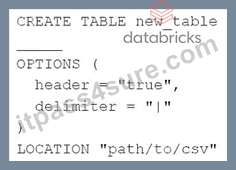
Which of the following lines of code fills in the above blank to successfully complete the task?
- A. None of these lines of code are needed to successfully complete the task
- B. USING CSV
- C. FROM CSV
- D. FROM "path/to/csv"
- E. USING DELTA
Answer: B
NEW QUESTION # 52
A data engineer wants to schedule their Databricks SQL dashboard to refresh every hour, but they only want the associated SQL endpoint to be running when it is necessary. The dashboard has multiple queries on multiple datasets associated with it. The data that feeds the dashboard is automatically processed using a Databricks Job.
Which of the following approaches can the data engineer use to minimize the total running time of the SQL endpoint used in the refresh schedule of their dashboard?
- A. They can ensure the dashboard's SQL endpoint is not one of the included query's SQL endpoint.
- B. They can ensure the dashboard's SQL endpoint matches each of the queries' SQL endpoints.
- C. They can turn on the Auto Stop feature for the SQL endpoint.
- D. They can set up the dashboard's SQL endpoint to be serverless.
- E. They can reduce the cluster size of the SQL endpoint.
Answer: C
NEW QUESTION # 53
A data analyst has created a Delta table sales that is used by the entire data analysis team. They want help from the data engineering team to implement a series of tests to ensure the data is clean. However, the data engineering team uses Python for its tests rather than SQL.
Which of the following commands could the data engineering team use to access sales in PySpark?
- A. spark.sql("sales")
- B. spark.delta.table("sales")
- C. SELECT * FROM sales
- D. There is no way to share data between PySpark and SQL.
- E. spark.table("sales")
Answer: E
Explanation:
The data engineering team can use the spark.table method to access the Delta table sales in PySpark. This method returns a DataFrame representation of the Delta table, which can be used for further processing or testing. The spark.table method works for any table that is registered in the Hive metastore or the Spark catalog, regardless of the file format1. Alternatively, the data engineering team can also use the DeltaTable.forPath method to load the Delta table from its path2. References: 1: SparkSession | PySpark
3.2.0 documentation 2: Welcome to Delta Lake's Python documentation page - delta-spark 2.4.0 documentation
NEW QUESTION # 54
A data engineer has realized that they made a mistake when making a daily update to a table. They need to use Delta time travel to restore the table to a version that is 3 days old. However, when the data engineer attempts to time travel to the older version, they are unable to restore the data because the data files have been deleted.
Which of the following explains why the data files are no longer present?
- A. The DELETE HISTORY command was run on the table
- B. The HISTORY command was run on the table
- C. The TIME TRAVEL command was run on the table
- D. The VACUUM command was run on the table
- E. The OPTIMIZE command was nun on the table
Answer: D
NEW QUESTION # 55
A data engineer has realized that the data files associated with a Delta table are incredibly small. They want to compact the small files to form larger files to improve performance.
Which of the following keywords can be used to compact the small files?
- A. COMPACTION
- B. VACUUM
- C. OPTIMIZE
- D. REPARTITION
- E. REDUCE
Answer: C
Explanation:
Explanation
OPTIMIZE can be used to club small files into 1 and improve performance.
NEW QUESTION # 56
A data engineer has been given a new record of data:
id STRING = 'a1'
rank INTEGER = 6
rating FLOAT = 9.4
Which of the following SQL commands can be used to append the new record to an existing Delta table my_table?
- A. INSERT VALUES ( 'a1' , 6, 9.4) INTO my_table
- B. INSERT INTO my_table VALUES ('a1', 6, 9.4)
- C. UPDATE my_table VALUES ('a1', 6, 9.4)
- D. UPDATE VALUES ('a1', 6, 9.4) my_table
- E. my_table UNION VALUES ('a1', 6, 9.4)
Answer: B
Explanation:
To append a new record to an existing Delta table, you can use the INSERT INTO statement with the VALUES clause. This statement will insert one or more rows into the table with the specified values.
Option A is the only code block that follows this syntax correctly. Option B is incorrect, as it uses the UNION operator, which will return a new table that is the union of two tables, not append to an existing table. Option C is incorrect, as it uses the INSERT VALUES statement, which is not a valid SQL syntax.
Option D is incorrect, as it uses the UPDATE statement, which will modify existing rows in the table, not append new rows. Option E is incorrect, as it uses the UPDATE VALUES statement, which is also not a valid SQL syntax. References: Insert data into a table using SQL | Databricks on AWS, Insert data into a table using SQL - Azure Databricks, Delta Lake Quickstart - Azure Databricks
NEW QUESTION # 57
An engineering manager wants to monitor the performance of a recent project using a Databricks SQL query.
For the first week following the project's release, the manager wants the query results to be updated every minute. However, the manager is concerned that the compute resources used for the query will be left running and cost the organization a lot of money beyond the first week of the project's release.
Which of the following approaches can the engineering team use to ensure the query does not cost the organization any money beyond the first week of the project's release?
- A. They can set the query's refresh schedule to end on a certain date in the query scheduler.
- B. They can set a limit to the number of individuals that are able to manage the query's refresh schedule.
- C. They can set the query's refresh schedule to end after a certain number of refreshes.
- D. They can set a limit to the number of DBUs that are consumed by the SQL Endpoint.
- E. They cannot ensure the query does not cost the organization money beyond the first week of the project's release.
Answer: A
Explanation:
In Databricks SQL, you can use scheduled query executions to update your dashboards or enable routine alerts. By default, your queries do not have a schedule. To set the schedule, you can use the dropdown pickers to specify the frequency, period, starting time, and time zone. You can also choose to end the schedule on a certain date by selecting the End date checkbox and picking a date from the calendar. This way, you can ensure that the query does not run beyond the first week of the project's release and does not incur any additional cost. Option A is incorrect, as setting a limit to the number of DBUs does not stop the query from running. Option B is incorrect, as there is no option to end the schedule after a certain number of refreshes.
Option C is incorrect, as there is a way to ensure the query does not cost the organization money beyond the first week of the project's release. Option D is incorrect, as setting a limit to the number of individuals who can manage the query's refresh schedule does not affect the query's execution or cost. References: Schedule a query, Schedule a query - Azure Databricks - Databricks SQL
NEW QUESTION # 58
A data engineer is using the following code block as part of a batch ingestion pipeline to read from a composable table:
Which of the following changes needs to be made so this code block will work when the transactions table is a stream source?
- A. Replace predict with a stream-friendly prediction function
- B. Replace spark.read with spark.readStream
- C. Replace "transactions" with the path to the location of the Delta table
- D. Replace format("delta") with format("stream")
- E. Replace schema(schema) with option ("maxFilesPerTrigger", 1)
Answer: B
Explanation:
Explanation
https://docs.databricks.com/en/structured-streaming/delta-lake.html
In the context of Databricks, when transitioning from batch processing to stream processing, one common change that needs to be made is replacing spark.read with spark.readStream. This modification is essential because spark.read is used for batch processing, while spark.readStream is used for stream processing. The rest of the code can often remain the same or require minimal changes. References: The information can be referenced from Databricks documentation on structured streaming: Structured Streaming Programming Guide.
NEW QUESTION # 59
An engineering manager wants to monitor the performance of a recent project using a Databricks SQL query.
For the first week following the project's release, the managerwants the query results to be updated every minute. However, the manager is concerned that the compute resources used for the query will be left running and cost the organization a lot of money beyond the first week of the project's release.
Which of the following approaches can the engineering team use to ensure the query does not cost the organization any money beyond the first week of the project's release?
- A. They can set the query's refresh schedule to end on a certain date in the query scheduler.
- B. They can set a limit to the number of individuals that are able to manage the query's refresh schedule.
- C. They can set the query's refresh schedule to end after a certain number of refreshes.
- D. They can set a limit to the number of DBUs that are consumed by the SQL Endpoint.
- E. They cannot ensure the query does not cost the organization money beyond the first week of the project's release.
Answer: A
NEW QUESTION # 60
A data engineer has configured a Structured Streaming job to read from a table, manipulate the data, and then perform a streaming write into a new table.
The code block used by the data engineer is below:
If the data engineer only wants the query to process all of the available data in as many batches as required, which of the following lines of code should the data engineer use to fill in the blank?
- A. trigger(parallelBatch=True)
- B. trigger(availableNow=True)
- C. trigger(continuous="once")
- D. processingTime(1)
- E. trigger(processingTime="once")
Answer: B
Explanation:
https://spark.apache.org/docs/latest/api/python/reference/pyspark.ss/api/pyspark.sql.streaming.DataStreamWriter
NEW QUESTION # 61
Which of the following statements regarding the relationship between Silver tables and Bronze tables is always true?
- A. Silver tables contain more data than Bronze tables.
- B. Silver tables contain aggregates while Bronze data is unaggregated.
- C. Silver tables contain a more refined and cleaner view of data than Bronze tables.
- D. Silver tables contain a less refined, less clean view of data than Bronze data.
- E. Silver tables contain less data than Bronze tables.
Answer: A
Explanation:
Explanation
https://www.databricks.com/glossary/medallion-architecture
NEW QUESTION # 62
Which of the following Git operations must be performed outside of Databricks Repos?
- A. Push
- B. Pull
- C. Commit
- D. Clone
- E. Merge
Answer: D
NEW QUESTION # 63
Which of the following is a benefit of the Databricks Lakehouse Platform embracing open source technologies?
- A. Simplified governance
- B. Ability to scale storage
- C. Avoiding vendor lock-in
- D. Ability to scale workloads
- E. Cloud-specific integrations
Answer: C
Explanation:
Explanation
https://double.cloud/blog/posts/2023/01/break-free-from-vendor-lock-in-with-open-source-tech/
NEW QUESTION # 64
Which of the following data lakehouse features results in improved data quality over a traditional data lake?
- A. A data lakehouse provides storage solutions for structured and unstructured data.
- B. A data lakehouse stores data in open formats.
- C. A data lakehouse supports ACID-compliant transactions.
- D. A data lakehouse allows the use of SQL queries to examine data.
- E. A data lakehouse enables machine learning and artificial Intelligence workloads.
Answer: C
Explanation:
A data lakehouse is a data management architecture that combines the flexibility, cost-efficiency, and scale of data lakes with the data management and ACID transactions of data warehouses, enabling business intelligence (BI) and machine learning (ML) on all data12. One of the key features of a data lakehouse is that it supports ACID-compliant transactions, which means that it ensures data integrity, consistency, and isolation across concurrent read and write operations3. This feature results in improved data quality over a traditional data lake, which does not support transactions and may suffer from data corruption, duplication, or inconsistency due to concurrent or streaming data ingestion and processing . References: 1: What is a Data Lakehouse? - Databricks 2: What is a Data Lakehouse? Definition, features & benefits. - Qlik 3: ACID Transactions - Databricks : [Data Lake vs Data Warehouse: Key Differences] : [Data Lakehouse: The Future of Data Engineering]
NEW QUESTION # 65
A new data engineering team team has been assigned to an ELT project. The new data engineering team will need full privileges on the table sales to fully manage the project.
Which of the following commands can be used to grant full permissions on the database to the new data engineering team?
- A. GRANT USAGE ON TABLE sales TO team;
- B. GRANT SELECT ON TABLE sales TO team;
- C. GRANT ALL PRIVILEGES ON TABLE sales TO team;
- D. GRANT ALL PRIVILEGES ON TABLE team TO sales;
- E. GRANT SELECT CREATE MODIFY ON TABLE sales TO team;
Answer: C
NEW QUESTION # 66
A data analyst has a series of queries in a SQL program. The data analyst wants this program to run every day.
They only want the final query in the program to run on Sundays. They ask for help from the data engineering team to complete this task.
Which of the following approaches could be used by the data engineering team to complete this task?
- A. They could wrap the queries using PySpark and use Python's control flow system to determine when to run the final query.
- B. They could submit a feature request with Databricks to add this functionality.
- C. They could redesign the data model to separate the data used in the final query into a new table.
- D. They could automatically restrict access to the source table in the final query so that it is only accessible on Sundays.
- E. They could only run the entire program on Sundays.
Answer: A
NEW QUESTION # 67
......
Databricks Exam Practice Test To Gain Brilliante Result: https://freetorrent.itpass4sure.com/Databricks-Certified-Data-Engineer-Associate-practice-exam.html
